
Reviewed 5 August 2026 by the Retaining Wall Pros editorial team
Drainage components and enquiry questions are useful preparation, but a lawful outlet and final design depend on the actual site and local requirements.
Drainage is a connected path
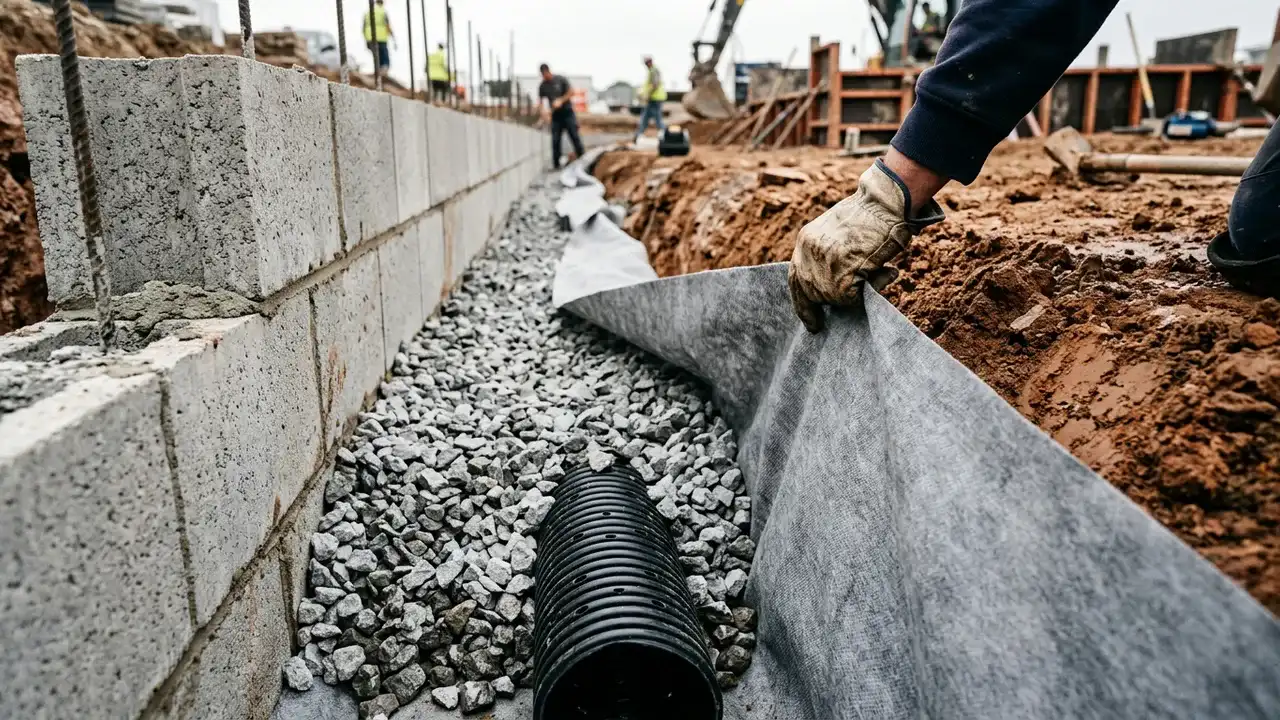
Water must move from the retained soil into a free-draining zone, through a filtered collection system and toward an appropriate outlet. A pipe without fall or a destination is not a complete system.
Keep soil and water roles separate
Geotextile helps limit fine soil migrating into drainage aggregate. Surface grading and interception may also be needed so runoff does not overwhelm the subsoil system.
Confirm the discharge point
Do not assume water can be released at a boundary or onto another property. Ask who confirms the lawful discharge path and how outlets can be inspected or maintained.
Separate surface water from subsoil water
Paving, roofwater, garden irrigation and overland flow can deliver water faster than a narrow drainage zone was intended to collect. The project brief should show how surface water is intercepted or directed and how water within the retained soil reaches the collection layer. A provider should explain what happens during intense rain, what remains accessible for inspection and which parts of the system depend on another contractor or existing stormwater infrastructure.
Write a maintainable drainage scope
Record aggregate type and extent, filter fabric position, pipe size and fall, junctions, clean-outs, outlets and surface grading. Ask how the system can be checked after the wall is complete and what evidence will be photographed before concealment. Where an existing wall is wet or moving, do not assume an added outlet alone fixes the cause; the wall, foundation, retained loads and current water paths need assessment together.
Use this guide on your project
- ✓Map roofwater, paving falls, irrigation, ponding, seepage and overland flow before selecting a drain.
- ✓Identify collection, filtration, pipe fall, inspection access and the proposed outlet as one connected path.
- ✓Ask who confirms the lawful discharge point and protects neighbours, services and council assets.
- ✓Keep surface-water management and subsoil drainage visible as separate but coordinated tasks.
Sources and review limits
- City of Gold Coast — Retaining walls
Primary council example confirming that stormwater impacts and property relationships form part of the local retaining-wall check.
- Standards Australia — AS 4678 Earth-retaining structures
Primary catalogue record for the earth-retaining-structures standard; project design must use the applicable current documents.
Sources can change. Recheck the current property, product and authority position before relying on a threshold, range or process.
Continue the decision
Retaining Wall Cost Guide
Understand the scope items that move a retaining-wall quote before comparing totals.
Retaining Wall Materials Comparison
Compare concrete sleepers, timber, reinforced block, natural stone and gabions by site fit and scope.
Engineering and Approvals
Use national principles, then check the current state, territory and council pathway for the property.
Open the related service guidance → Choose a location guide →
Prepare your project
Turn the guide into a project enquiry
Include the measurements, access and site constraints you have already collected.