
Reviewed 5 August 2026 by the Retaining Wall Pros editorial team
Visible symptoms can help prepare an assessment but cannot establish the concealed cause from a photograph. Obtain an on-site assessment before choosing a repair boundary.
Record what has changed
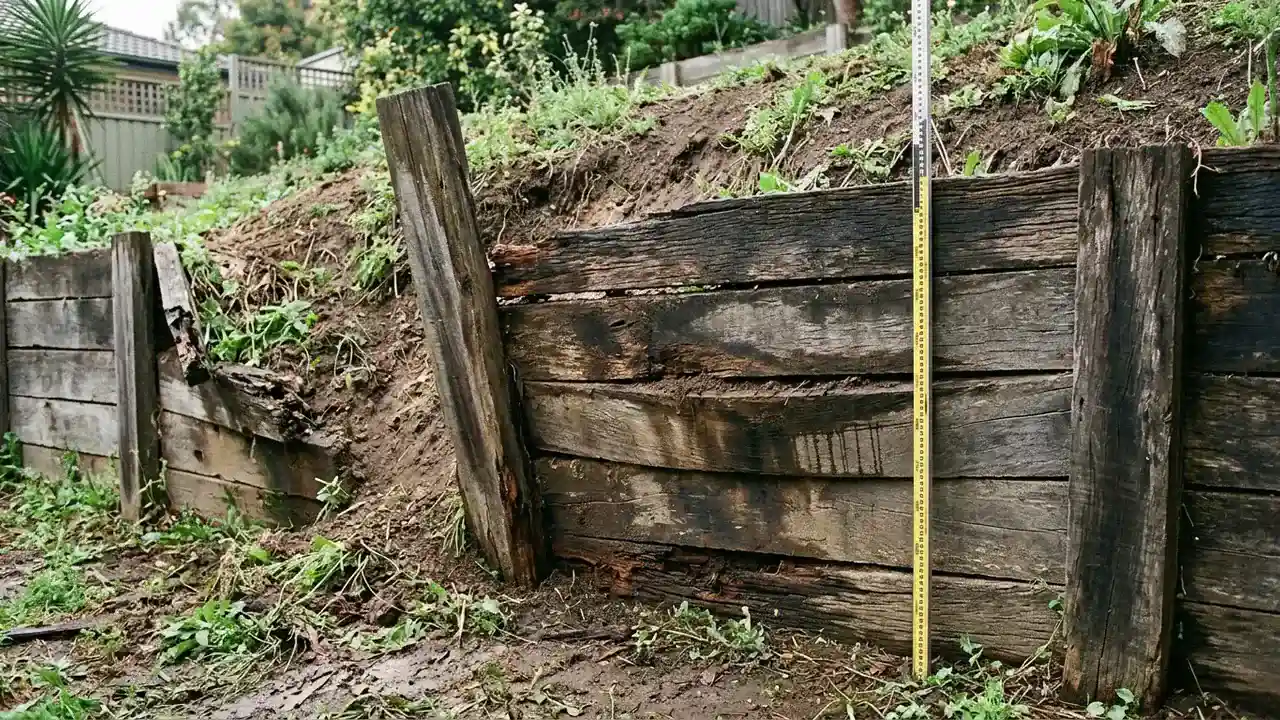
Photograph leaning, bulging, cracking, decay, washout, water staining and soil loss from safe positions. Note whether the change is recent, progressive or associated with heavy rain or nearby work.
A local repair may not address the cause
Replacing one sleeper or post can be appropriate in some circumstances, but drainage, footing, retained load and neighbouring sections need assessment before assuming the defect is isolated.
Escalate active risk
Do not work below or beside a wall showing active movement or imminent collapse. Restrict access and seek prompt advice from an appropriately qualified local professional or relevant service.
Define the repair boundary
A repair proposal should identify every component being removed, retained or added and explain how retained components were assessed. Ask whether posts, footings, reinforcement, drainage, backfill and neighbouring wall sections are accessible for inspection. If the provider cannot confirm concealed work until excavation, the quote should state the investigation step, temporary stability approach and variation process rather than implying a fixed repair outcome from photographs.
Compare service life and disruption
Replacement may cost more and disturb more landscaping, but a narrow repair can inherit the remaining life and limitations of older components. Compare access, temporary support, demolition, disposal, drainage, approval, reinstatement and future inspection in both options. Ask what evidence would cause the proposed repair to stop and become a larger replacement, and agree how that decision is documented before additional work proceeds.
Use this guide on your project
- ✓Photograph the full wall, top and bottom of slope, drainage, upper loads and adjacent structures from safe ground.
- ✓Record when movement or water symptoms began and whether rain or nearby work changed them.
- ✓Ask what old components remain, what evidence supports keeping them and how that limits the outcome or warranty.
- ✓Compare repair and replacement using the same investigation, drainage, approval, demolition and reinstatement boundary.
Sources and review limits
- Sunshine Coast Council — Retaining walls and permits
Primary council example showing that construction, modification and repair can require a current permit check.
- Standards Australia — AS 4678 Earth-retaining structures
Primary catalogue context for earth-retaining structures; assessment and design remain project-specific.
Sources can change. Recheck the current property, product and authority position before relying on a threshold, range or process.
Continue the decision
Retaining Wall Cost Guide
Understand the scope items that move a retaining-wall quote before comparing totals.
Retaining Wall Materials Comparison
Compare concrete sleepers, timber, reinforced block, natural stone and gabions by site fit and scope.
Retaining Wall Drainage Guide
See how collection, filtration and lawful discharge work together behind a retaining wall.
Open the related service guidance → Choose a location guide →
Prepare your project
Turn the guide into a project enquiry
Include the measurements, access and site constraints you have already collected.